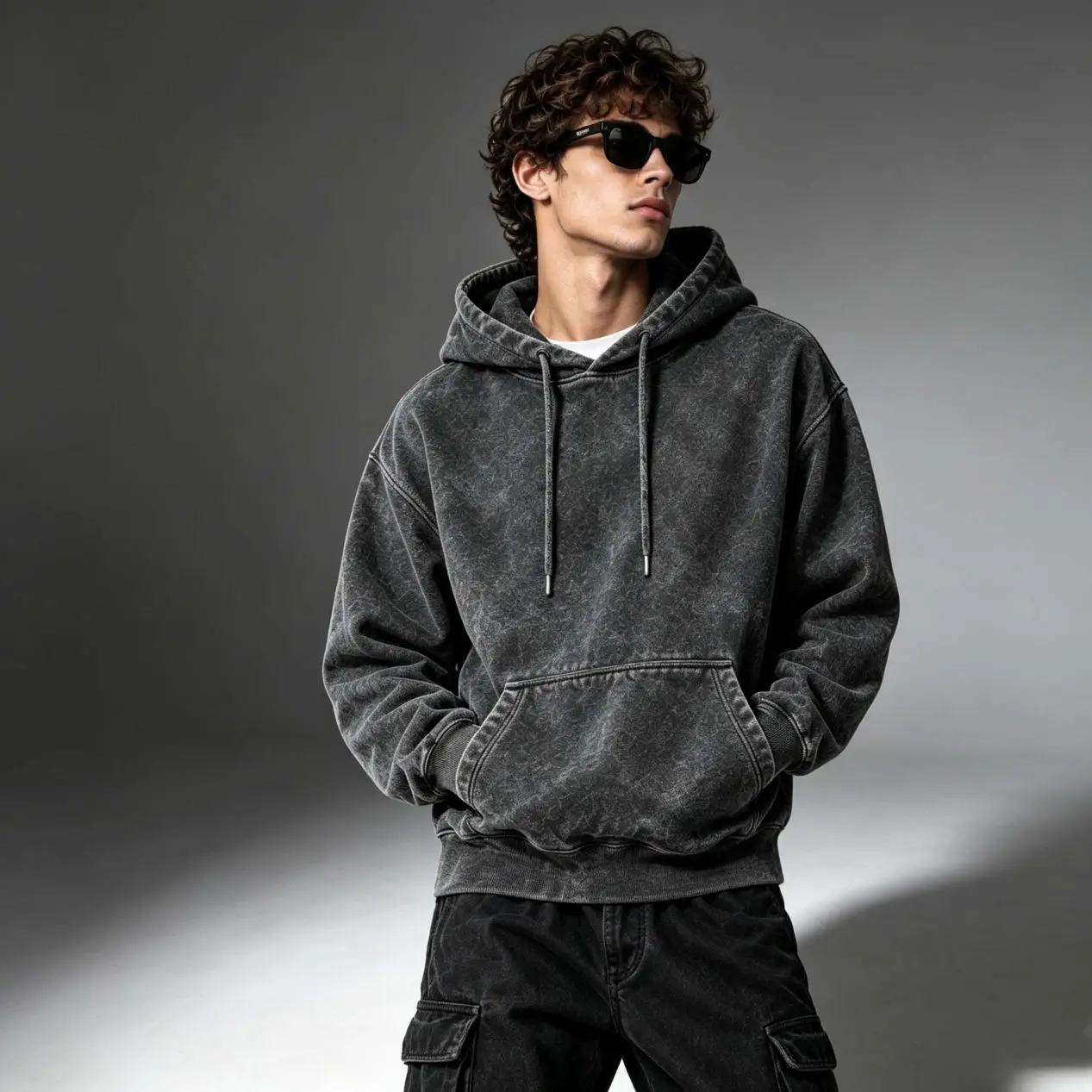
Why Washed Knit Outerwear Is an Engineering Challenge
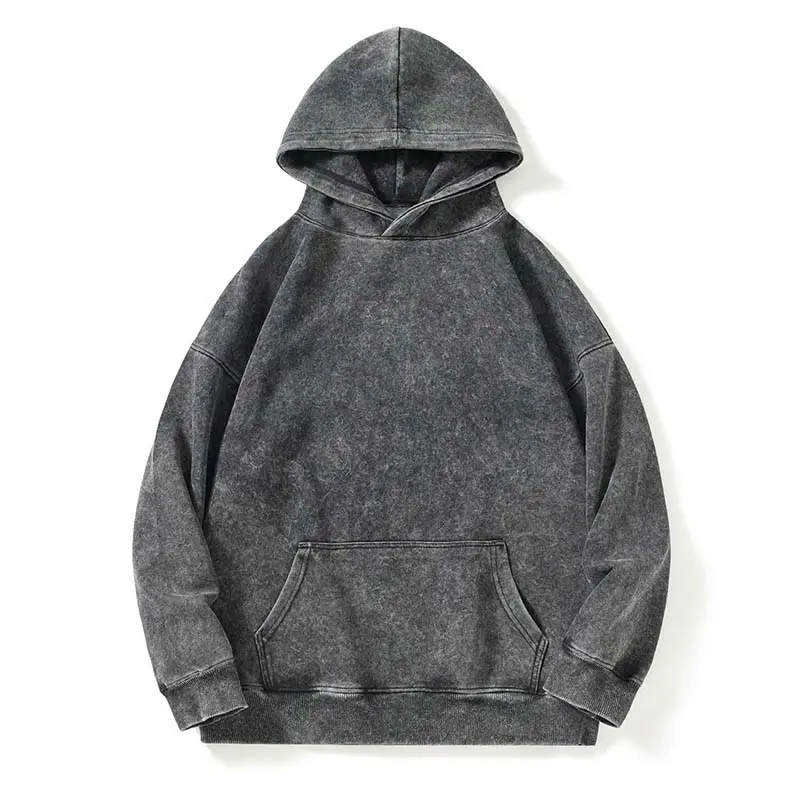
A vintage-washed French terry jacket is one of the most commercially successful items in modern streetwear. It bridges the comfort of a 450+ GSM loopback hoodie with the structural presence of a tailored chore coat.
However, moving a heavy knit jacket through an industrial wash house is a high-risk operation. Unlike rigid woven canvas, knitted loops react dynamically to water temperature, mechanical abrasion, and chemical stripping. Without exact engineering, brands end up with warped zipper plackets, destroyed ribbing, erratic shrinkage across grading sizes, and fabric abrasion that ruins the garment.
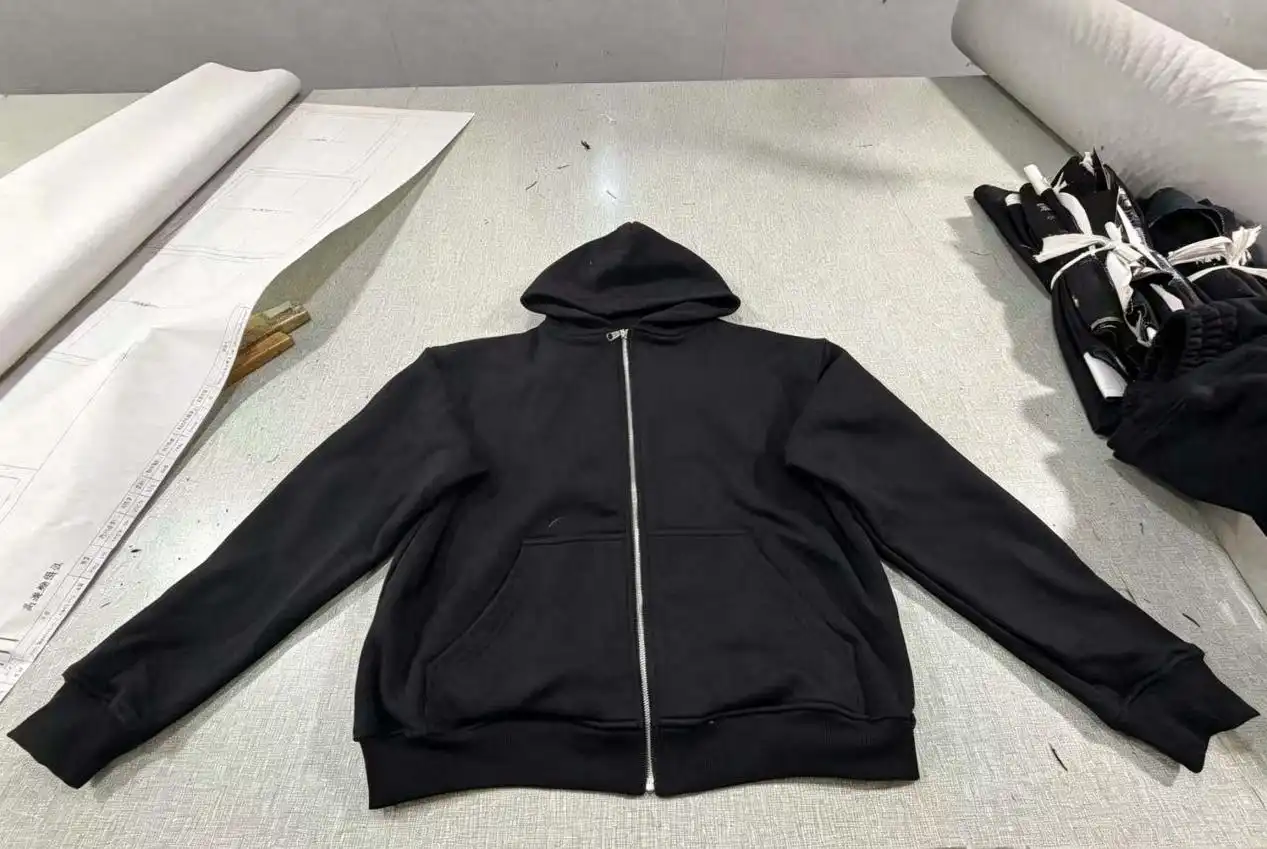
Here is the exact production blueprint we use to take a raw, unwashed French terry jacket from the cutting table, through the wash drums, to final dimensional inspection.
1. The Production & Wash Sequence
[Shrinkage-Calibrated PFD Pattern Cutting] – [Assembly with 100% Cotton Thread]
▼
[Pre-Wash Sizing Audit]- [Cold Pigment / Reactive Dyeing] – [Enzyme Stone Washing]
▼
[Acid Neutralization & Silicone Softening] -[Tensionless Rotary Drying]
▼
[Hardware Post-Installation / Riveting] – [Final Spec Audit against Tech Pack]
2. Stage-by-Stage Wash House Operations
Stage 1: Shrinkage Calibration & PFD Construction
The Oversized Grading Ratio: Heavy French terry shrinks anywhere from 6% to 11% across the warp (length) and 3% to 5% across the weft (width) during hot water tumbling. Cutting directly to finished Tech Pack specs guarantees undersized garments. We run test-wash swatches per fabric batch and cut the raw Prepared-for-Dye (PFD) shells on an oversized shrinkage-graded pattern.
Dye-Receptive Stitching: Garments are assembled exclusively using 100% long-staple cotton thread or specialized dye-receptive core thread. Standard polyester threads resist cotton dyes, which creates harsh, mismatched white seams across dark washed garments.
Stage 2: Pigment / Reactive Garment Dyeing
The assembled jackets are loaded into industrial side-loading extractors. For subtle tonal depth, low-impact reactive dyes are applied. For vintage, high-contrast seam highlights, cold pigment dyes are introduced at ambient temperatures to coat only the surface fibers while leaving the internal loopback lighter.
Stage 3: Controlled Bio-Enzyme Stone Washing
Cellulase Enzyme Action: Instead of aggressive raw pumice stones that tear knit loops, we introduce bio-polishing cellulase enzymes combined with rounded synthetic stones.
Targeted Abrasion: The enzymes selectively digest loose micro-fibrils on the exterior face. The stones gently abrade structural high points—collar edges, pocket seams, and elbow reinforcements—creating authentic vintage fading without thinning the base cloth.
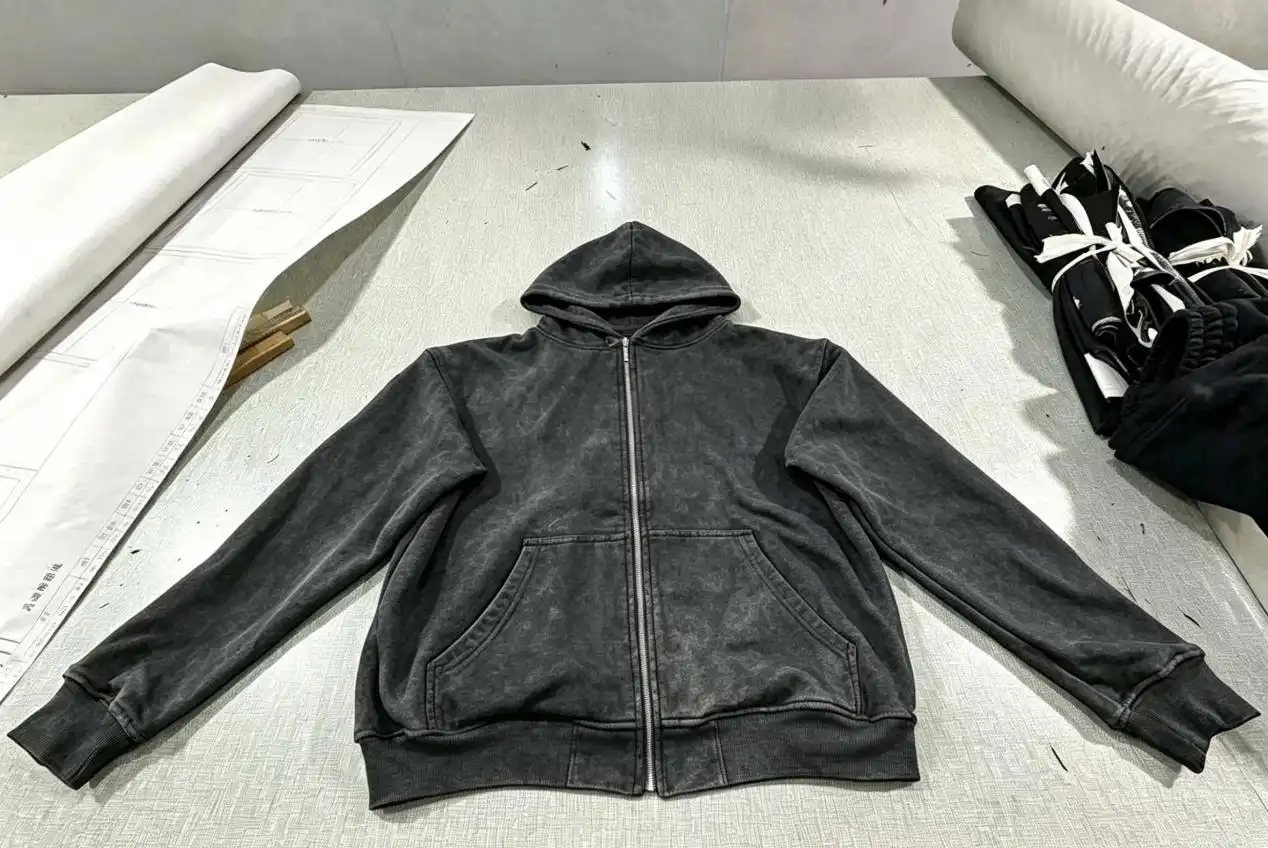
Stage 4: Neutralization & Micro-Silicone Softening
Halting Chemical Action: An acid neutralization bath immediately halts the enzyme degradation, preserving the tensile burst strength of the knit (Grade 4+).
Restoring Hand-Feel: Industrial washes strip natural cotton oils, leaving knitwear dry. A cationic micro-silicone emulsion bath coats the cotton fibers, giving the heavy terry a supple, broken-in drape.
Stage 5: Tensionless Rotary Drying & Hardware Attachment
Garments undergo centrifugal water extraction followed by controlled hot-air tumbling at 70°C (158°F). This step completes the mechanical shrinkage lock.
Protecting Trims: High-abrasion wash cycles strip plating off metal hardware. To avoid scratched sliders or oxidation, heavy two-way antique brass zippers and custom-engraved snaps are installed after the wet process, or protected using specialized rubber wash-guards.
3. Factory Execution: Sourcing Safeguards
| Failure Point | Why It Happens in Standard Factories | The Bespoke Production Safeguard |
| Misaligned Art Across Zipper | Bulk cutting without registration pins | Hand-mapped digital cutting templates with manual grain matching |
| Fraying Seams After Washing | Using basic 3-thread overlock stitching | 5-thread safety overlocking + full internal lining construction |
| Bulky, Lumpy Neck & Cuffs | Folding thick 500 GSM tapestry into ribbing | Shaved seam allowances paired with high-recovery custom knit ribbing |
| Stiff, Unwearable Drape | Poor yarn blend or over-tight tension | Calibrated cotton-poly warp ratios offering structured volume without rigidity |
Scale Your Washed Outerwear with Bespoke
Executing high-end washed knitwear requires unified coordination between the cutting room and the wash technician.
At Bespoke, we manage the full custom manufacturing workflow—from PFD pattern adjustments and custom pigment formulations to heavy stone-washing, precision hardware setting, and final dimensional quality control.